Collaborators and Acknowledgements
Graph of Collaborators
I am extremely interested in the stories and social dynamics behind academic papers, and a huge part of that is how collaborations form. That is why I want to try to include, progressively, on my website the stories behind some of my papers: how collaborations form, how ideas come to life, and how we overcame some of the difficulties in our papers.
A first step towards that goal is to create my network of collaborators on all my papers, both preprinted/published and in progress!
This is also a way for me to try to thank the people that have influenced my academic life substantially.
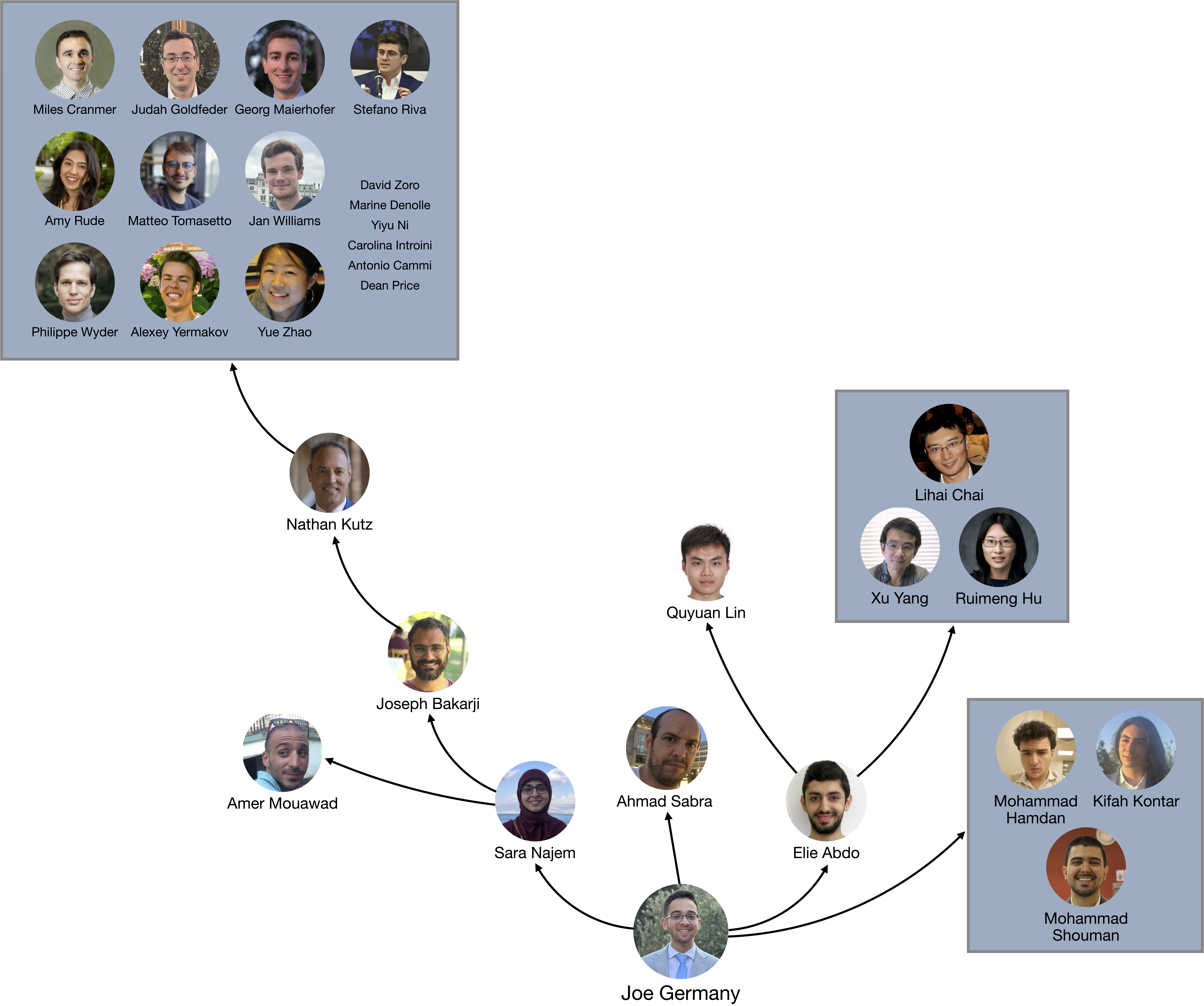
(Edges emanating from me are people whom I have met myself through a program or a course, or as friends in AUB. The other edges denote the person that introduced me to the other.)
Please entertain me by reading through some network theoretic statistics and/or puns:
- The node with the highest betweeness centrality is Prof. Sara Najem, through which the greatest number shortest paths pass and without whom my academic experience would be unimaginably different.
- My longest chain is:
Me-Sara-Joseph-Nathan-CTF Group, which is insanely satisfying to look at. - If we, instead, think of the simplicial complex constructed from coauthors on my papers, the biggest simplices are those resulting from the CTF4Seismology and CTF4Nuclear papers (see papers [3] and [6] respectively in readme), which are both 16-simplices. This is an unjustifiably fancy way of saying that these are my papers with the most coauthors.
(This section will be updated when I think of more puns.)
I have personally first met:
- Prof. Sara Najem through the Summer Research Experience in Physics (in high school) in the June 2022.
- Prof. Joseph Bakarji through Prof. Sara Najem in June 2024.
- Prof. Nathan Kutz through Prof. Joseph Bakarji in February 2025.
- The CTF group (the clique of people in the top left corner) through Prof. Nathan Kutz, progressively starting February 2025.
- Prof. Amer Mouawad through Prof. Sara Najem first in November 2024, but then for the sake of a project in May 2026.
- Prof. Ahmad Sabra through the Math 210 (Introduction to Real Analysis course) in January 2025, but then for the sake of a project in May 2026.
- Prof. Elie Abdo through the Summer Research Experience (in the Math department) in June 2025.
- Profs. Lihai Chai, Ruimeng Hu, and Xu Yang through Prof. Elie Abdo in November 2025.
- Prof. Quyuan Lin through Prof. Elie Abdo in January 2026.
Some Acknowledgements
My love for interdisciplinary work and my interest in a multitude of fields/subfields of physics, network science, and machine learning are definitely inspired by Prof. Sara Najem, who was my first contact with a professional academic. Before meeting her, I wanted to major in computer engineering; however, she turned my attention onto the very rich world of computational physics and I decided to switch over to physics/math (one of the best decisions of my life thus far). She is a person of incredibly diverse interests. I am particularly lucky to have been in her proximity for the last 4 years, especially during the exciting times when she comes up with cool, new ideas. I am indebted to her for having introduced me to an incredible array of people, an infinitesimal subset of whom I have eventually collaborated with, and to which she repeatedly oversold my skills ;).
An amazing portion of my knowledge in scientific machine learning is indebted to conversations with Prof. Joseph Bakarji. Many of my views on what constitutes a good research question, how to carry meaningful research in ML, how to write/expose, and how to create succinct diagrams for method papers are partially stolen from him. I have benefitted greatly from seeing how he works and thinks. My vision of the field, its many moving parts, and how to think of scientific paradigms are inspired by countless long meetings with him. I am also particularly thankful for him involving me in the CTF4Science program with Prof. Nathan Kutz, and for granting me my first research assistantship.
Last but not least, I am incredibly grateful to Prof. Elie Abdo for introducing me to the tools and questions of the field of analysis of PDEs (in particular for fluid mechanics) and for nurturing my mathematical maturity. Working with him played a major role in convincing me that I wanted to pursue mathematics as a career. His love for rigor and his passion to look at everything through the lens of analysis are what led me down the path of getting into the theoretical analysis of ML algorithms. He has also been VERY generous in his time and ideas. We have spent uncountably many hours together wrestling with a problem and/or gossiping, through which I have witnessed his astonishing mathematical creativity. He is an incredibly charismatic person with a nice sense of humor, a (comedically exaggerated) disdain for algebra (and truly any field other than PDEs), and surprisingly good songs. He has also introduced me to a group of his collaborators (Profs. Lihai Chai, Ruimeng Hu, Xu Yang, Quyuan Lin), with whom I have greatly enjoyed working.
Moreover, I learned how to conduct large scale science and how to collaborate on a large project through the CTF4Science team, which has been extremely rewarding.